
Wedding processional order: who walks in, and when
It is the question that always lands three weeks before the wedding, usually the moment a mother innocently asks: "and when do I walk in?". The entrance is the only moment of the day when everyone looks in the same direction at the same time. It lasts four minutes, it takes ten to prepare, and when it has not been prepared, everyone can tell.
The wedding processional order does not follow the same customs depending on where you are. And if you are planning a wedding in France, there is a further twist: you will almost certainly have two ceremonies, each with its own etiquette. Here is how it works, who walks with whom, and the mistakes I see every season in Provence and the Southern Alps.
What a wedding processional actually does
The processional is the walk that brings your loved ones, then the couple, to the ceremony. It is not a formality: it is a staging tool. It creates silence, it builds attention, and it produces the contrast that makes your arrival unforgettable.
The principle never changes: you walk in from the least awaited to the most awaited. The couple always closes the procession, because emotion should peak, not fade. If you remember one thing from this article, make it that one.
A very concrete timing marker: an entrance song runs about three and a half minutes. That is the real length of your processional. Allowing eight to ten seconds between each pair, you have room for eight to twelve people, not thirty. A processional that runs too long always ends the same way, with someone cutting the music mid-phrase.
Getting married in France: two ceremonies, two entrances
This is the point that surprises almost every couple planning a destination wedding in France, so let us be clear about it early. In France, only the civil ceremony at the town hall is legally binding. No church service and no symbolic ceremony has any legal value on its own.
In practice, this means you will have two entrances to plan, and they are nothing alike:
The mairie, the town hall ceremony. Short, official, often in a small room, held by a registrar. This is the one that legally marries you.
The ceremony that matters emotionally, religious or symbolic, held wherever you like, with the staging you want. This is where the real processional happens.
Many international couples hold the civil ceremony on the Friday, in a small group, and the main celebration on the Saturday in a Provencal mas. It is the smoothest way to organise it, and it frees your main day entirely. Residency requirements and paperwork for a civil wedding in France are detailed on the French public service website.
Processional order at the mairie
The town hall is the most constrained setting and the least codified. The wedding room is often small, guests are usually already seated, and the registrar has another couple booked behind you. There is no real processional here, only an order of arrival.
One partner enters first, traditionally the groom on his mother's arm, and stands before the registrar's table.
The witnesses follow and take their reserved seats. In France you need two witnesses minimum, four maximum.
The bride enters last, traditionally on her father's arm.
More and more couples simply walk in together, hand in hand, which fits what a civil marriage actually means: an equal commitment before the law. If being "given away" makes you uncomfortable, walk in as a pair. Nobody will bat an eyelid.
Three practical points French town halls rarely mention: seating is limited, sometimes to twenty or thirty people; many mairies forbid throwing petals or confetti on the forecourt; and slots run back to back, so arriving ten minutes late shortens your ceremony, not the next couple's. Arrive fifteen minutes early.
Processional order in church
This is the most codified of the three settings, and the one where international couples are most often caught out, because the French Catholic tradition brings the parents in as crossed couples.
The groom, on his mother's arm. He opens the procession and takes his place at the altar.
The groom's father, on the bride's mother's arm. The famous crossing of the families.
The grandparents, if they are present and able.
The witnesses, then the bridesmaids and groomsmen, in pairs.
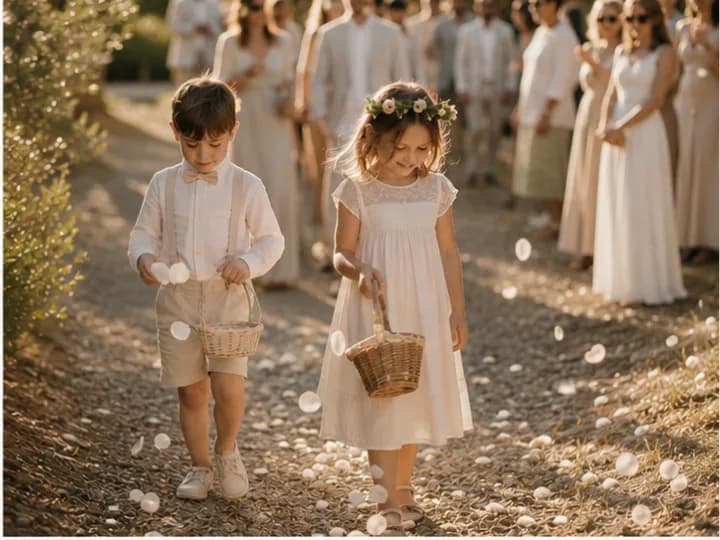
The flower girls and page boys, just before the bride.
The bride, on her father's arm, last.
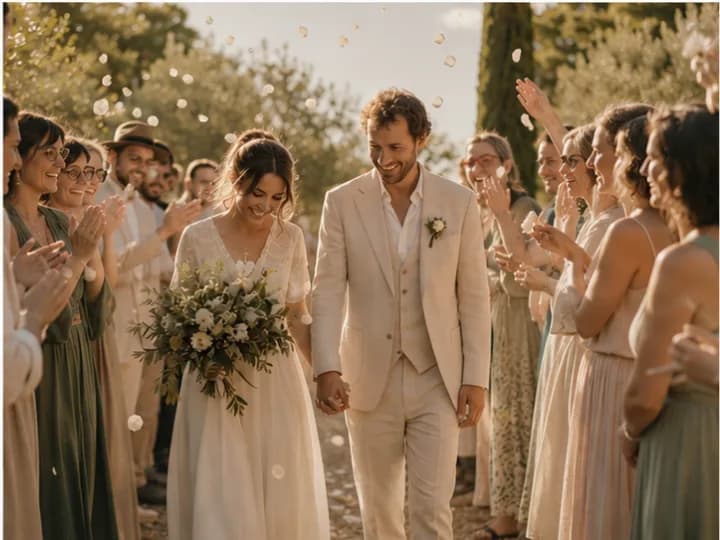
If you are used to the Anglo-American format, note two real differences. There is no aisle-side seating rule by family in most French churches, and the couple leaves first at the end, greeted by a guard of honour formed by their guests outside the church. That exit is often the best photograph of the day.
One word on blended families, because it comes up constantly and no etiquette guide answers it. There is no protocol. What works is giving everyone a clear role rather than a rank in an old order: a step-parent who reads a text, a half-brother who carries the rings, a step-mother seated in the front row. A role settles things far better than a rank.
Processional order for a symbolic ceremony
Here everything is allowed, which is exactly what destabilises people. No protocol, no authority, no tradition to respect: only the effect you want to create. The smoothest running order, and the one I use most often:
The celebrant and musicians take their places discreetly, before anyone else.
The friends and family who will speak sit in the front row, so they can stand without disturbing anyone.
Grandparents and parents walk in and are seated at the front.
The witnesses, then the bridesmaids and groomsmen.
The flower girls and page boys.
The couple, together or one after the other.
The variation I love: the first partner walks in at the head of the procession and waits turned towards the aisle rather than facing the celebrant. They watch the other arrive. Photographers adore it, because that is where the real, unrepeatable reaction happens.
A Provence-specific point worth knowing: a late afternoon ceremony with the sun aligned with the aisle gives beautiful backlit images but forces your guests to squint for forty minutes. Test it at the exact ceremony time, not at midday during the venue visit. And plan around the mistral, which can lift a lightweight aisle runner in seconds. The full running order is covered in my guide to the symbolic ceremony.
Who walks the bride down the aisle
This is the most emotionally loaded question in the whole article, and there is no wrong answer. Whether the father is absent, estranged, no longer alive, or simply because the tradition does not speak to you, every option is a good one:
Her mother. Increasingly common, and always moving.
Both parents, one on each side.
A brother, a sister, a grandparent, or whoever truly mattered.
Her child, to honour the family already built.
Alone, in full confidence, to symbolise a free choice.
With her partner, walking the aisle together.
One solution I often suggest when several people matter equally: the relay. One person for the first half of the aisle, another taking over halfway. It sounds complicated written down and reads perfectly in real life, provided you rehearse it once on site.
My planner's advice: choose what feels like you, not what is expected of you. And tell the person concerned well in advance, explaining why. Processional wounds are never caused by the choice itself, only by discovering it at the last minute.
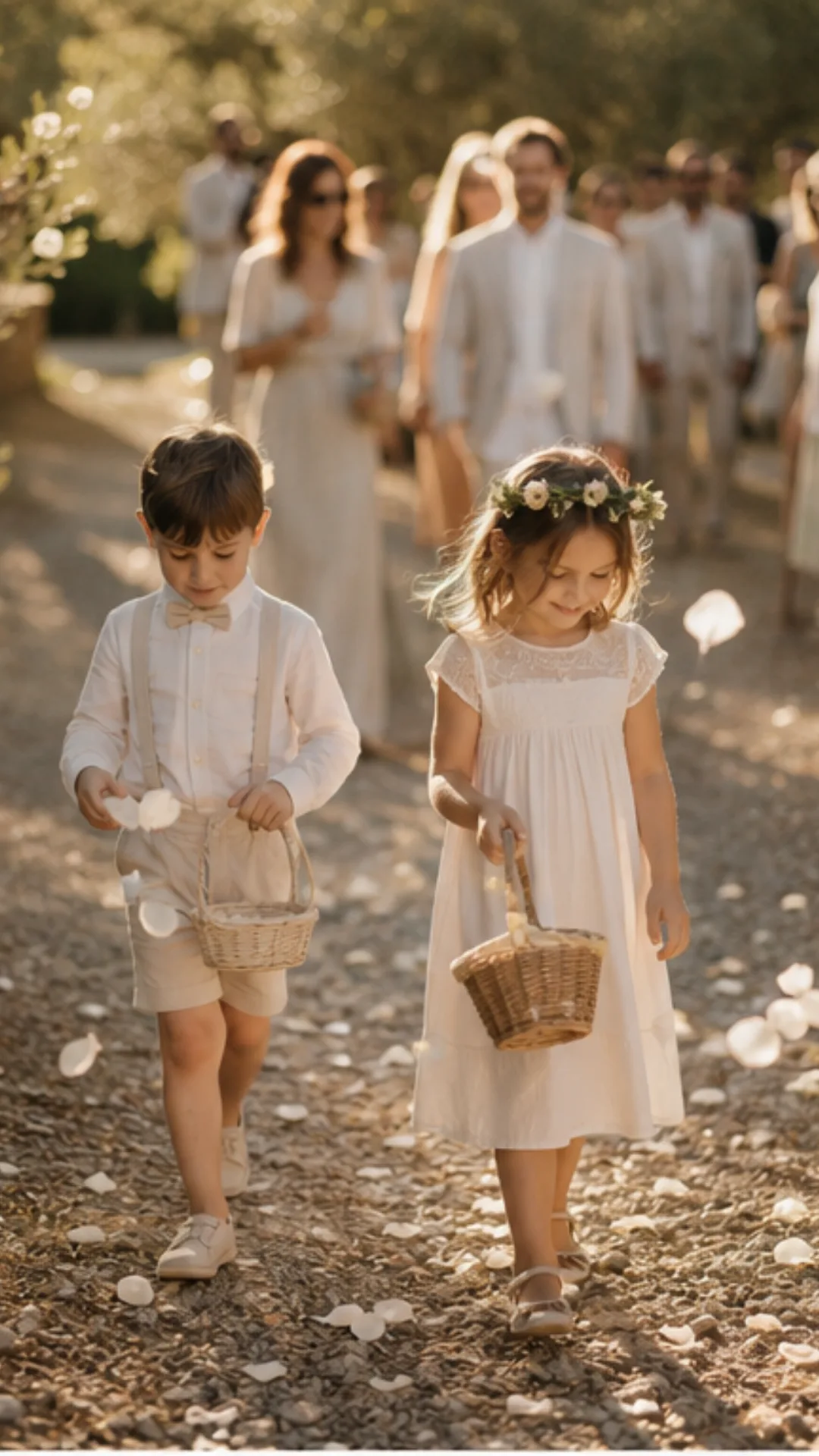
Children in the processional
A successful children's processional comes down to three decisions made in advance, never to improvisation on the day.
Age. Under three, the child will not cross the aisle alone, whatever the parents promised. Between three and six it works if an adult waits at the end, visible and arms open. From seven, they handle it, often better than the adults.
Number. Beyond six it stops being a processional and becomes a school outing. Four is a good figure.
The minder. Appoint one adult, not the children's own parents, to gather them ten minutes before and collect them on arrival.
Never give the real rings to a child under seven. The ring cushion travels with two decorative bands, and the real rings stay in a witness's pocket. Trust me, the lawn of a Provencal mas is a very poor place to look for a wedding ring.
What ruins an entrance
Starting before the photographer is in position. There is no second take. The go signal belongs to the coordinator, not to the most impatient person present.
Bunching the pairs together. Allow four to five metres between each group, or every photograph shows one compact crowd.
Forgetting to brief the grandparents. They are in the processional, so they must not already be seated. This is the number one oversight.
A song that is too short. Choose a longer track with a planned fade rather than an abrupt cut.
Not telling guests to stay seated. Without instruction, half the room stands up with phones raised and blocks the aisle. One sentence from the celebrant solves it.
Add one more for international weddings: guests arriving from abroad on the morning itself. Flight delays are real, and the processional is the part of the day that cannot start without the people in it. Ask key participants to arrive the day before, and build it into your wedding planning timeline.
How it actually runs on the day
In practice, a processional takes ten minutes to prepare the day before and three minutes to run on the day. Here is my method, which you can apply even without a planner.
The day before, I write the order on one sheet, name by name, and send it to everyone involved. Not a battle plan: six lines. On the day, fifteen minutes before, I gather everyone away from the guests, have each person say aloud who they follow, and we do a thirty-second dry run. It sounds like school, it takes less than a minute, and it removes every hesitation.
Then I launch the entrances one by one, on the photographer's signal and on the music. The couple sees none of it: they are behind a door or a wall, with someone telling them simply "you're on". That is precisely my job, and it is what day-of coordination covers. For couples marrying in France from abroad, it also means someone on the ground who speaks to your venue, your registrar and your suppliers in French, which matters more than anything on the morning itself.
In short
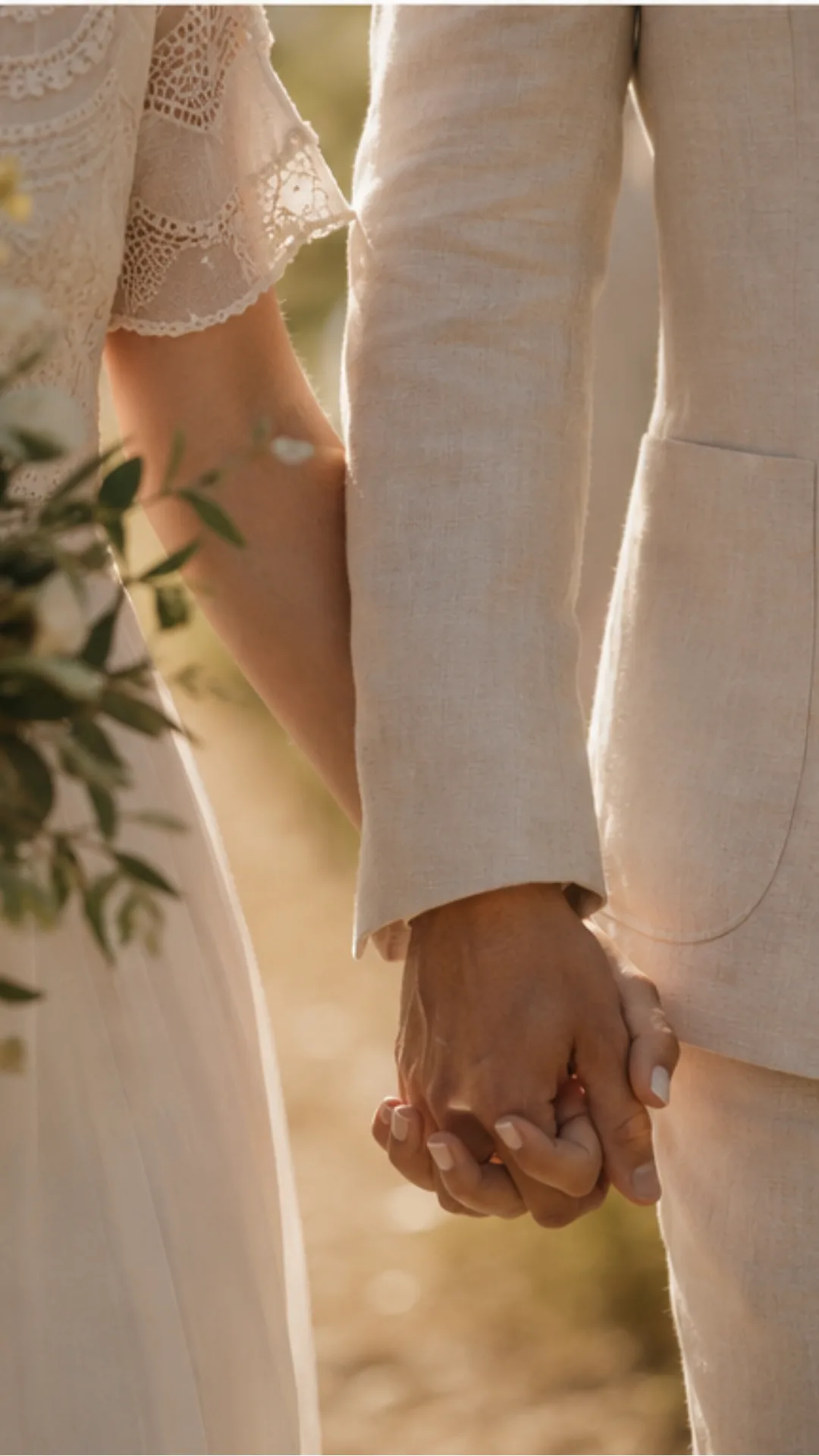
The wedding processional order comes down to three rules. You walk in from the least awaited to the most awaited, and the couple always closes. The town hall and the church follow precise customs, a symbolic ceremony follows none. And anything not said out loud the day before will be paid for in hesitation the next day. Write six lines, run a thirty-second rehearsal, and let the emotion do the rest.
You want that entrance to land perfectly, without giving orders at your own wedding, and without managing French suppliers from another country? Have a look at my planning packages or let us talk it through on a discovery call. And if you are still choosing when to marry in Provence, start with how to choose your wedding date.
FAQ
How long does the processional last?▾
Do we need a processional for the French civil ceremony?▾
Can we have our symbolic ceremony on a different day from the civil one?▾
Can we decline to include someone in the processional?▾
What happens if it rains during an outdoor ceremony?▾
Would you like a wedding that truly reflects you? Book your free video discovery call:
Book my free video callCredits
Illustrative images, AI-generated or royalty-free.
Dear photographers,
Could your photos illustrate this article?
Text me!