
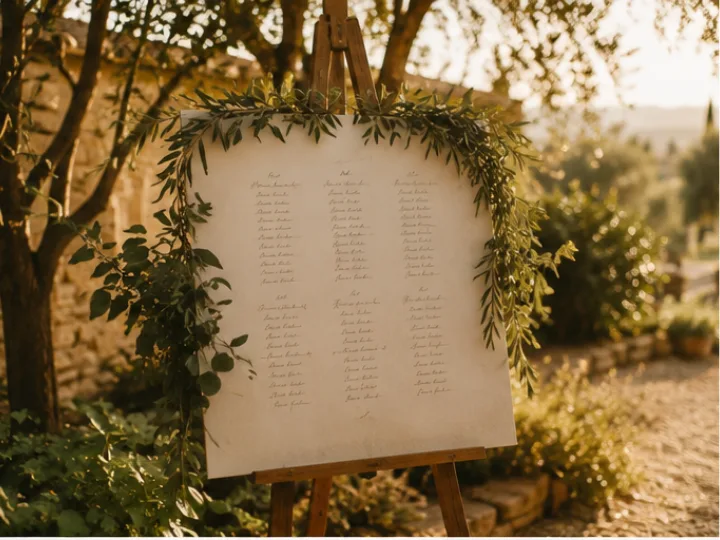
Wedding seating plan: the complete method, from centimetres to the tricky cases
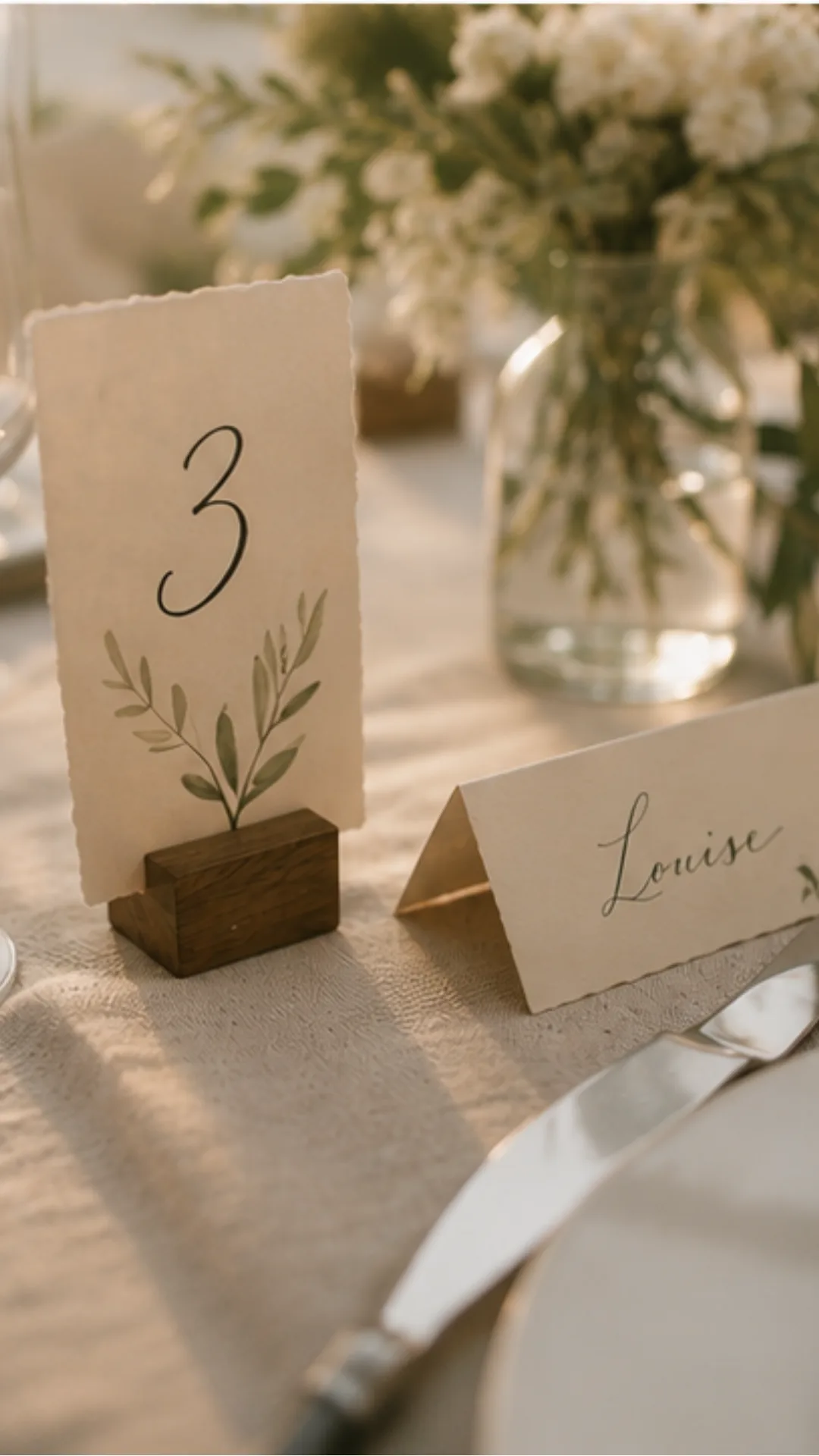
The seating plan is the task everyone postpones, and it makes sense: it is the only part of the whole wedding where you have to choose between people you love. It is not a logistics exercise, it is diplomacy disguised as a spreadsheet.
The good news: a wedding seating plan follows concrete rules, centimetres, dates and an order of operations. Once those rules are set, the plan almost writes itself, and only three or four human cases remain that really need thinking about. Here is the method I use on every one of my weddings.
When to do your seating plan, and why not earlier
It is the most common mistake and the most draining one: starting too early. A seating plan built six months ahead will be redone four times, because it relies on a number you do not have yet, the exact headcount.

In my timeline, the seating plan is updated four weeks before, the same day the final headcount goes to the venue and the caterer. Before that, you work on assumptions. After that, you work on facts.
Eight weeks before, the working draft. You lay out the big families and the big groups, no final names. It is a draft, and that is fine.
Four weeks before, the real version. The headcount is locked, you know who is coming. This is when the plan is truly built, together with the room layout.
Two weeks before, the frozen version. It goes to the venue and the caterer with the other working documents. After that, every change costs time, and money.
Between then and the day, the adjustments. There will be some. Plan them in pencil, not in marker.
All of this assumes your guest list is settled and your reminders are done. If you are still chasing answers, the seating plan is not what is blocking you, the step before is. The full calendar is in my article on the wedding planning timeline.
The centimetres nobody looks at
Before placing a single name, you need to know how many tables fit in the room and how many people fit around each table. Couples skip this part, and it is the one that ruins everything: a beautiful plan on paper, impossible to set up on the day.
Round table, 150 cm diameter: 6 to 8 guests. Eight is already tight with plated service.
Round table, 180 cm: 10 guests comfortably, 12 at a push.
Rectangular table, 200 x 80 cm: 6 to 8 guests depending on whether someone sits at the ends.
Per guest, allow 60 cm of width minimum, 70 cm to be truly comfortable. Under 60, your guests eat elbow to elbow for three hours.
Between two tables, 1.50 m. It is not a luxury: chairs pushed back on both sides, plus room for the service. Below that, the staff pass plates over people's heads.
These numbers do not negotiate with the shape of your room. That is why the seating plan and the room drawing are done at the same time, never one after the other. I wrote a dedicated article on the room layout (dedicated blog article coming soon).
One last point couples discover late: your caterer has a say too. Service direction, where the back kitchen is, the distance to the furthest table. Show them your plan before you print it, not after.
The couple's table: three options, three consequences
There is no right answer, there are three choices and each one has a price.
The classic top table. Your witnesses and closest family. Reassuring for the families, and the best way to spend your dinner with people you already see at Christmas. Keep it for simple families, in the geometric sense.
The table for two, the "sweetheart table". Just the two of you, facing the room. It is the rising choice, and often the fairest: you finally eat together (!), you see everyone, and nobody is offended since nobody is chosen.
The couple split up. Each of you at a different table, among the guests. Very warm, very risky: you will not share dinner, and on the day it is your only seated moment. I advise against it, unless it really is your style.
Whatever you choose, one rule always holds: the couple's table can be seen from everywhere, with its back to a wall or a pretty backdrop, never to the kitchen door.
Seating people: the method in four passes
Do not try to place a hundred people at once, nobody can. Work in successive layers, each one easier than the last.
Pass 1, the groups. Close family, childhood friends, colleagues, sports friends, neighbours. You place groups, not individuals, and you already know how many tables each group needs.
Pass 2, the anchors. At each table, find the person who connects everyone and gets the conversation going. A table without an anchor is a silent table.
Pass 3, the physical constraints. Older guests away from the speakers and near an exit. Families with babies near the door. Guests with reduced mobility on a wide aisle. These come before affinities, always.
Pass 4, the special cases. This is where you slow down, and that is normal: three or four are left, not thirty.
A benchmark from the field: allow two to three hours for the first complete version, and expect three or four versions. If it takes you a whole week-end, you are stuck on one special case, not on the method.
When half your guests fly in
A destination wedding in France adds a layer the French version of this article does not need.
Mix languages on purpose, with a bridge. Seating all the French speakers together and all the English speakers together feels safe, and it splits your wedding in two. Mix them, but put one bilingual guest at every mixed table. That person is your anchor.
Group the jet-lagged. Guests who landed that morning will fade around 10pm. Seat them near the exit and away from the dance floor speakers, they will thank you.
Write the signage for everyone. Table names that work in both languages (villages, grape varieties, mountain peaks), and an alphabetical board by surname. Nobody should need a translation to find their chair.
Collect dietary needs early. International guests often have requirements that French caterers do not see every day. They belong in the plan at four weeks, not in an email the night before.
The cases that cause trouble
They come back at every wedding, in the same order. Better to see them coming.
Divorced parents. If the divorce is recent or tense, they are not seated together, and there is no visible hierarchy between them. Two tables of equal importance, at equal distance from you. A new partner sits at their table, not elsewhere.
Family feuds. You know them, so do your parents. Separate them, but not at opposite ends of the room, which is even more visible. Two different tables in the same area is enough.
The guest who comes alone. Never in a group where everyone has known each other for twenty years. Seat them at a mixed table, next to an anchor.
Children. Under six, they stay with their parents. Older, a children's table works, as long as it is within the parents' sight or one adult is in charge.
Drinks-only guests. They are not on the seating plan, so out of tact, the plan is displayed in a separate space or after they leave.
Original seating plan ideas, without the gimmicks
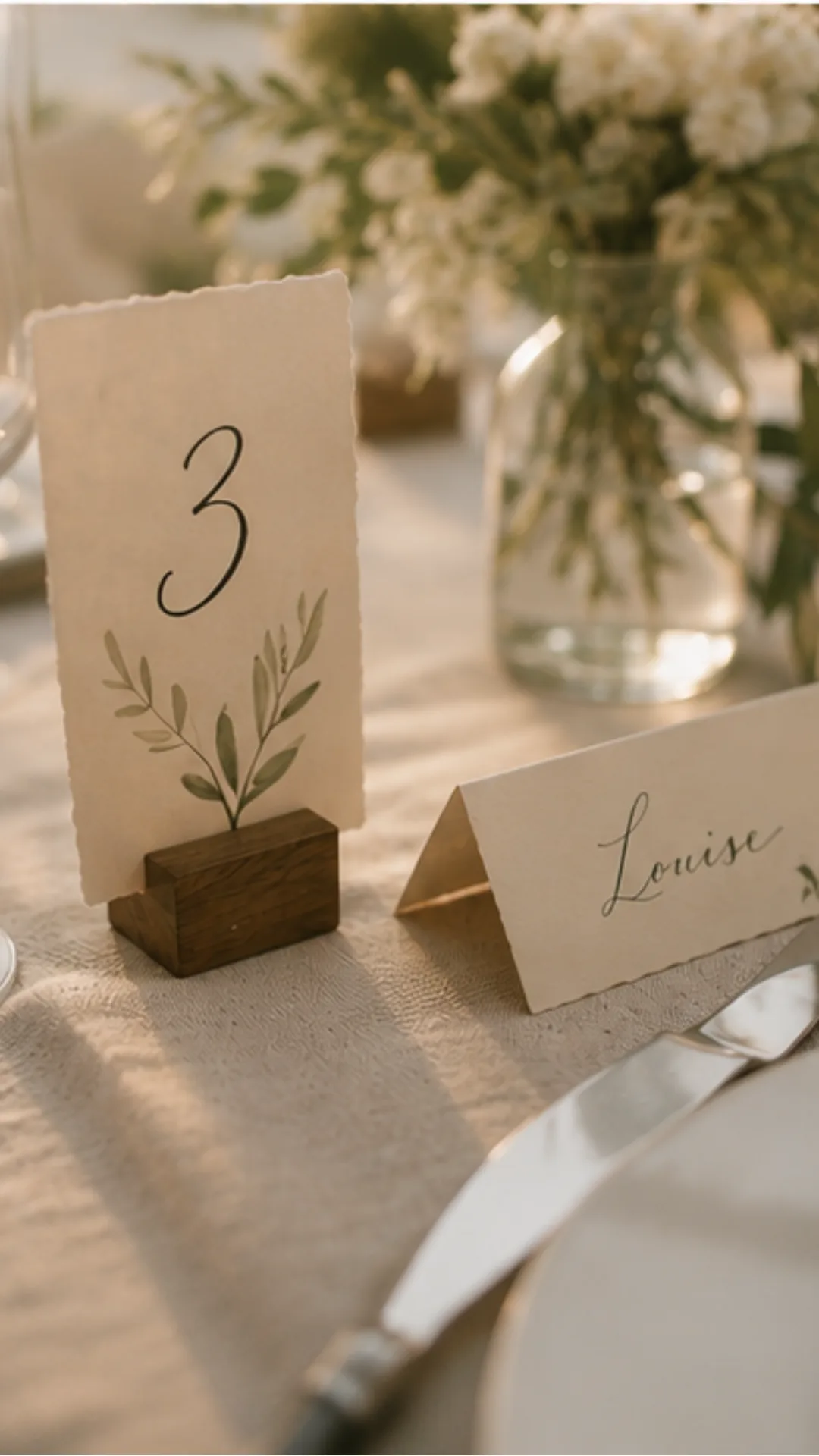
An original seating plan is judged on how easy it is to read, not on its creativity. Your guests read it standing, a glass in hand, often in dim light, sometimes without their glasses.
Name the tables instead of numbering them. Places that matter to you, villages, grape varieties, song titles, mountain peaks. The simplest and most effective idea: it tells a story without complicating anything.
Double display. An alphabetical board by surname at the entrance, and the table name on each table. Guests find their seat in ten seconds instead of wandering.
A style that follows the venue. A rustic plan in raw wood, rope and greenery works in a barn and clashes in an 18th-century salon.
Photos. A seating plan with photos is lovely and hard to keep up to date: every last-minute change means reprinting. Keep it for small weddings.
What to avoid: very fine handwriting on a dark background, white calligraphy on a mirror facing a window, and anything that asks your guests to solve a riddle to find their chair.
The display: board, place cards, or both
The board at the entrance. Essential above fifty guests. Wide enough for three people to read side by side, and high enough: on an easel one metre off the floor, it is unreadable as soon as there are two rows of people in front.
Place cards on the table. They settle who sits where around the table, which the board does not. Check the spelling of every name: it is the detail that hurts most, and the one most often missed.
Printed copies. Print three on paper on top of the board: one for the caterer, one for the venue, one for whoever coordinates the day.
Boards and signage deserve their own article, in the seating plan sign (dedicated blog article coming soon).
Tools: online, free, or spreadsheet
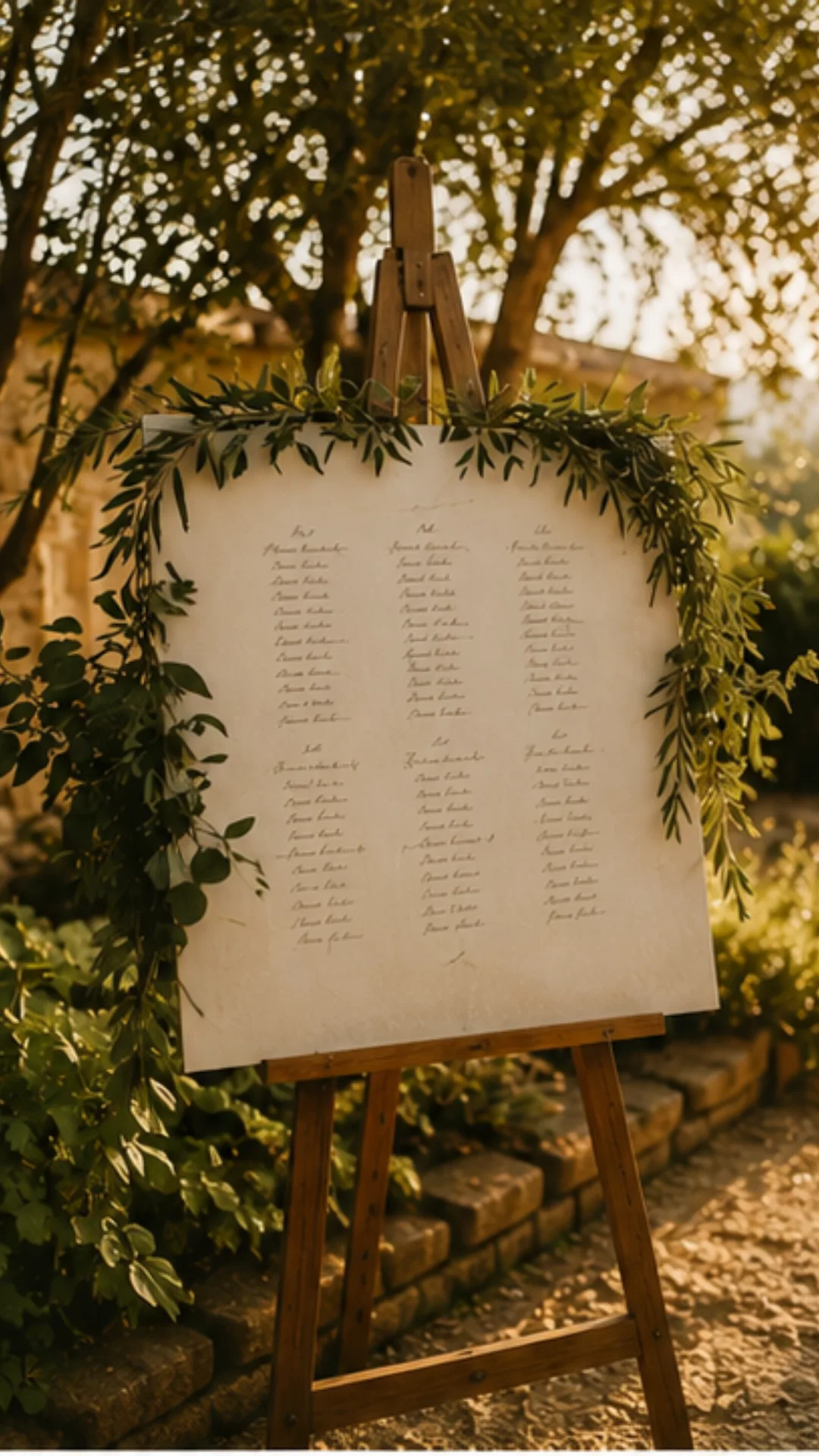
There are dozens of online seating plan tools, many free. They all draw tables and drop names in. Three details really set them apart: entering the real dimensions of your room, a printable PDF export at a usable size, and dietary requirements, because your caterer will ask for them four weeks before. A spreadsheet does the job for the first two passes. I compare the options in my article on seating plan tools (dedicated blog article coming soon).
For my couples, this is built into their client space: guest list, answers, diets and allergies arrive in one place, and the seating plan is built from checked data rather than a file copied by hand.
On the day, your seating plan is no longer yours
A seating plan, however perfect, is a dead document until someone brings it to life. On the day, someone has to set up the board in the right place at the right time, lay the place cards in the right order, handle the two or three last-minute cancellations by removing covers before anyone notices, and guide lost guests while you are having your photos taken. That is not your job, nor your witness's in a long dress.
It is exactly what wedding day coordination covers. And to see what a well-run day looks like hour by hour, read my article on the wedding day schedule (dedicated blog article coming soon).
In short
A good seating plan is not a pretty plan, it is a plan that holds up on the day. Settle your guest list, wait for the final headcount, measure the room before seating anyone, work in layers, and leave the three or four special cases for last.
And if you are still hesitating over one seat, ask yourself the only question that counts: will this person have a good evening here ? Not: is this the done thing ?
Want someone to hold all of this for you, from the final headcount to the board set up on time ? Let us talk on a discovery call, or have a look at wedding day coordination.
FAQ
Do we need a seating plan for the drinks reception?▾
Can we get married without any seating plan?▾
Who decides the seating, the couple or the parents?▾
What if someone cancels the day before?▾
Should children have their own table?▾
Would you like a wedding that truly reflects you? Book your free video discovery call:
Book my free video callCredits
Illustrative images, AI-generated or royalty-free.
Dear photographers,
Could your photos illustrate this article?
Text me!