
Eco-friendly wedding: where it actually counts
An eco-friendly wedding is not a sad wedding, it is not a hessian-and-jam-jar wedding, and it is certainly not a perfect one. It is a series of sensible choices, some of which genuinely change something and many of which only ease the conscience. The whole difficulty lies in telling them apart.
At Vert Le Mariage I prefer the word eco-sensitive: we lay down stepping stones, we do not make anyone feel guilty. And if you are reading this while planning a wedding in France from another country, there is an elephant in the room. Let us deal with it first, honestly, because no article on the subject ever does.
The destination wedding question, answered honestly
If you are flying guests to France, their flights are your footprint. Not the confetti, not the paper stock of your invitations, not the jam jars. A handful of long-haul flights outweighs your decoration, your stationery and your favours put together, several times over.
I am not going to tell you to cancel. You are marrying where you want to marry, often where one of you is from, and that is legitimate. But pretending the flights do not count while agonising over recycled paper is the one thing I will push back on. So here is what actually moves the needle when the travel itself is a given:
Make the journey worth it. One flight for a four-day stay is the same flight as for a weekend, spread over more days of joy. Encourage guests to make it a holiday. This is the single most useful thing you can do.
Invite fewer people. Uncomfortable, and true. Every name removed from a destination guest list removes a return flight. It is by far the most powerful lever, and it usually makes for a better wedding anyway. Start with your guest list, not with your venue.
Take the train where it exists. From the UK, Belgium, the Netherlands and much of Germany, Avignon TGV and Aix-en-Provence TGV are reachable by rail with a change in Paris or Lille. For a good number of your European guests it is a genuine alternative, not a sacrifice. Say so on your wedding website, with the actual route.
Hire locally, everything. Some couples fly in their own photographer, their own florist and their own decorator. That doubles the travel footprint and takes the money out of the region hosting you. Local suppliers are the point, not a compromise.
On carbon offsetting: it does not undo a flight, and anyone telling you otherwise is selling something. It is better than nothing, it is not absolution. Treat it as a donation, not a reset button.
One last thought, and it is the one I actually believe: a wedding that brings people together properly, in one place, for several days, is not the enemy of a considered wedding. It is often the most meaningful version of it.
What an eco-friendly wedding really is
It is a wedding that reduces its footprint without sacrificing any of the emotion: less waste, local and seasonal resources, materials reused rather than bought new for twelve hours of use.
And here is what it is not, because this is where most disappointment hides. It is not a wedding without flowers, without proper tableware and without music. It is not a purity contest where one slip cancels the rest. And it is not necessarily cheaper, as we will see.
The heaviest item: travel
Beyond the flights we have just discussed, the same logic applies on the ground. Choose a venue where everything happens in one place: ceremony, drinks, dinner and beds. You remove the shuttles between three addresses, and you also remove the question of who has been drinking and who is driving.
Organise car sharing properly. Not a line on the invitation, but a real shared spreadsheet with departure points and times. Without organisation, nobody does it.
The venue
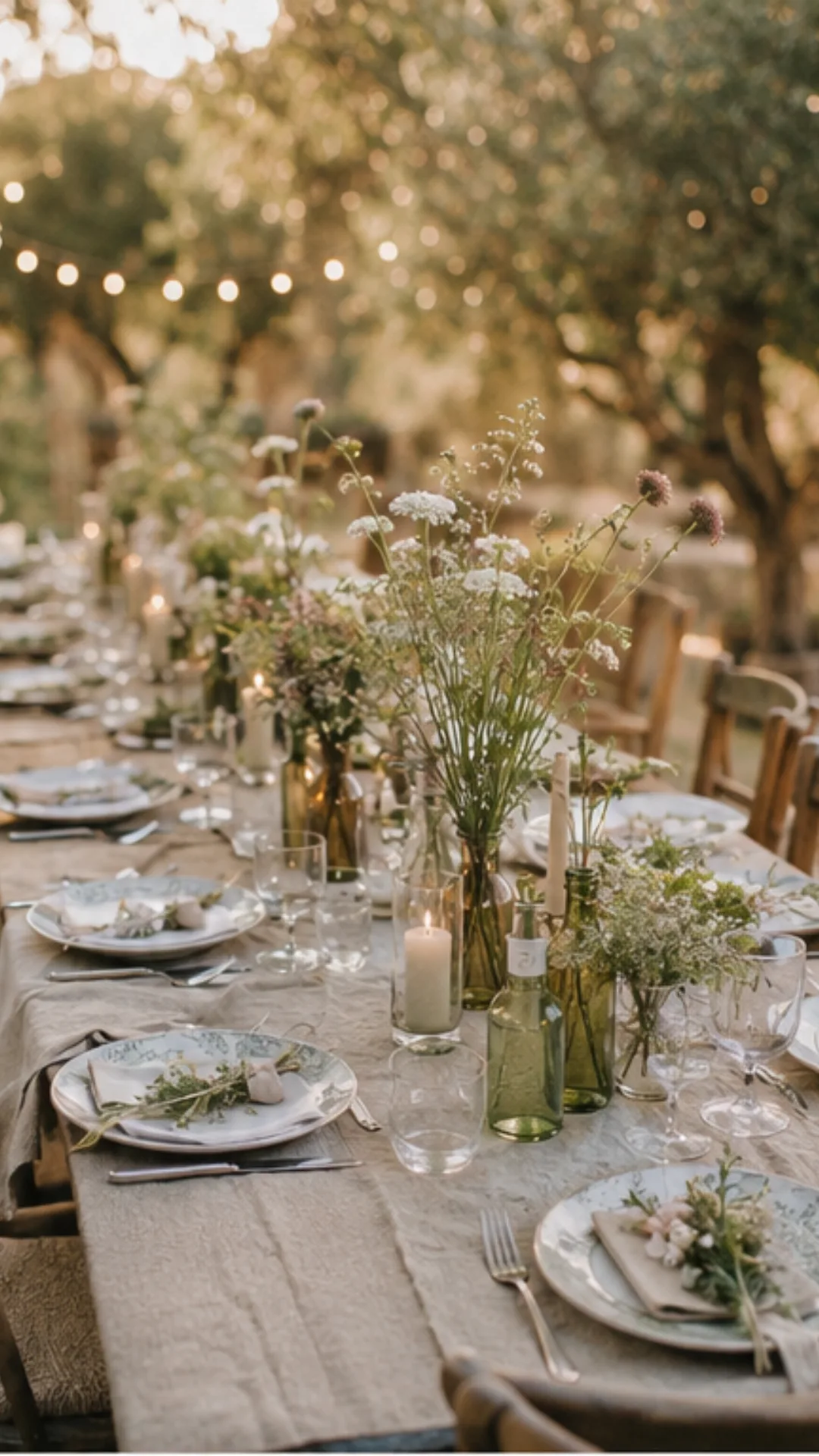
A venue that gathers everything and houses your guests does more for your footprint than fifty decoration decisions. Provencal mas estates lend themselves to this particularly well: ceremony in the garden, dinner under the plane trees, rooms on site, and often a kitchen open to local caterers.
Questions worth asking on the visit, which nobody thinks to ask:
Is there recycling on site, and who handles it after you leave?
What heats the water? Some estates run on solar, others on oil.
Can composting toilets be installed, and where?
Does the venue impose its suppliers? An exclusive catering deal can destroy your plan for a local menu.
How many people can genuinely sleep on site, sofas not included?
And a free lever: the season. A wedding in May, September or October needs far less cooling, ice and energy than one in the middle of August, and it is cheaper and more comfortable for everyone. In Provence that matters more than most people expect, which is why I wrote about marrying in autumn and about choosing your date.
The food
A genuinely committed caterer is recognised not by their pitch but by three verifiable things: where their produce comes from, what happens to what is not eaten, and how they handle tableware.
Local and seasonal. Ask for their supplier list, not a general promise. A serious caterer hands it over without hesitating.
A real vegetarian option. Not the sad plate of vegetables served to whoever declared it. A proper dish, offered to everyone, cuts the footprint of the meal significantly without anyone feeling punished.
Leftovers. Nothing obliges a wedding caterer in France to donate them, unlike supermarkets. But many will agree if you ask in advance and it is written into the contract. Ask at signature, not at midnight.
Tableware. Real crockery, hired rather than disposable, including at the drinks reception. It looks better, and across a hundred guests the cost difference is far smaller than you would think.
One observation from the field: waste at a wedding rarely comes from the main course. It comes from an oversized drinks reception and a late-night buffet nobody touches. Adjust those two with your caterer and you cut the waste and the bill at once.
Flowers
This is where the gap between the image and the reality is widest. A large share of cut flowers sold in France is imported, often from East Africa or the Netherlands, with cold chain and air freight. A peony in September did not grow near you.
The simple reflex: ask your florist what is in bloom on your date, in your region, and build from there. You will get more surprising and often more beautiful arrangements than the standard catalogue. The Collectif de la Fleur Française lists French growers and lets you check seasonality.
An honest caveat, because nobody tells you this: French-grown flowers often cost more than imported ones. You are paying for local labour and for production without heated greenhouses. If your budget is tight, reduce the volume rather than abandoning local: three generous arrangements beat fifteen small ones, and they look better.
For decoration in general, the rule is one word: hire. Tableware, furniture, arch, lanterns, drapes. These are objects used for twelve hours. Hiring costs less than buying, does not fill your garage, and removes the question of what to do with it afterwards. It also means you are not shipping decoration across a border.
Stationery
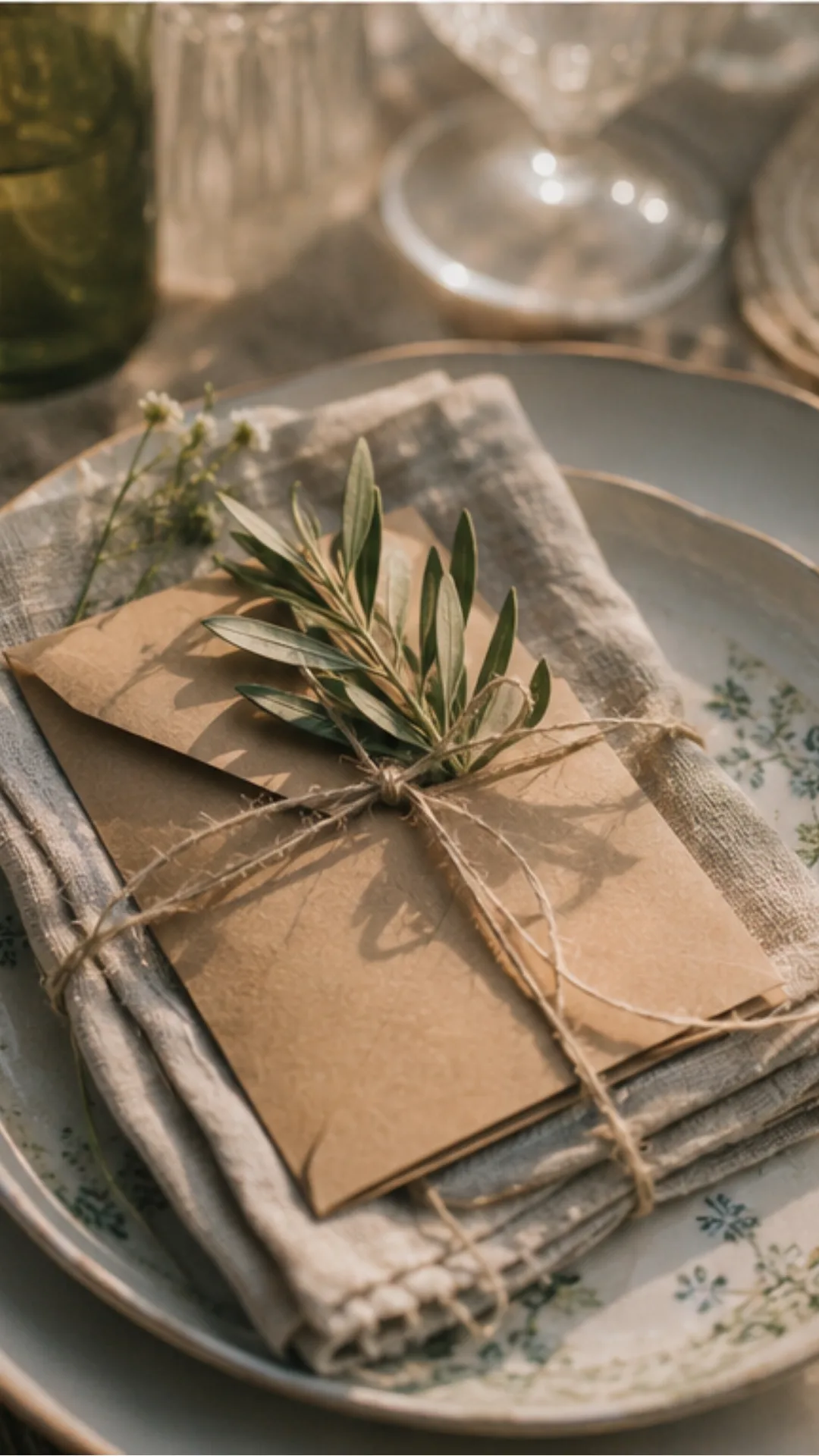
Invitations printed in France, on recycled or certified paper, with vegetable-based inks. Ask about the paper weight: thick and understated makes more impression than foiling.
Paper for the invitation itself, digital for everything else: reminders, directions, replies, registry. The best compromise between the pleasure of post and restraint. It also saves posting heavy card across the world.
A wedding website replaces the dozen printed extras, and you reprint nothing when a time changes.
On the day, one large sign at the entrance rather than a booklet per person. Better looking, more legible, and no paper collected from under the chairs.
For the writing itself, my examples and formulas are gathered in my article on wedding invitation wording.
Outfits and rings
Rental. Widely available now, including on beautiful pieces. For a garment worn a single day, it is the most coherent solution.
Second-hand. Wedding dresses are, by definition, worn once. The market is excellent and the prices incomparable. Just budget for alterations.
The piece you will wear again. The strongest argument for a suit or a jumpsuit: a beautiful ivory jumpsuit comes out again for other occasions, a gown with a train does not. It also travels in hand luggage, which matters here.
On rings, recycled gold is now offered by many jewellers and costs no more, gold being infinitely refinable without loss of quality. Ask about the origin of the stones too: it is a legitimate question and a serious jeweller answers it willingly. A family engagement ring, reset to your taste, remains the finest option of all.
Favours and the day itself
Let us be blunt: half of all wedding favours end up forgotten in the hallway dish. What genuinely works, in order: nothing at all but a handwritten word on the place card, something edible, something plantable, or a donation to a charity made in your guests' name and announced on the table. That last one has an interesting side effect: it is the one people talk about afterwards.
Then there is the part nobody anticipates, and where half of a zero-waste wedding is actually decided, at two in the morning:
Sorting. Three clearly marked bins where people actually walk, and one person responsible for them. Without a named person, everything ends up in the same bag by the end of the night.
Cups. Reusable and deposit-based at the drinks reception and the late bar. This is where disposables disappear by the hundred.
Composting toilets. They can be hired, they are clean, and they look far better than chemical cubicles. Allow roughly two units per hundred guests, and check delivery access.
The next day's flowers. Decide who takes them, or offer them to guests at the brunch.
The strike-down. The item missing from every planning timeline. Who clears, when, and where does the waste go? Put it in your timeline like everything else.
What it costs
Cheaper: hired decoration, second-hand, the pre-owned dress, favours removed, an adjusted drinks reception, hired rather than bought tableware.
About the same: the local seasonal caterer, recycled gold rings, recycled stationery.
More expensive: French-grown flowers, composting toilets, and certain artisan suppliers whose work is simply paid properly.
Overall, an eco-sensitive wedding usually costs about the same, with the budget distributed differently: fewer objects, more craftsmanship. Many couples find it actually saved them money, simply because the approach forces you to ask, line by line, whether each one is really needed.
Choosing suppliers, and spotting greenwashing
The fastest route to a genuinely eco-friendly wedding is to surround yourself well. Three questions separate the real from the marketed, immediately:
Where do your products or materials come from? Either a precise answer with names, or a vague one. There is no in-between.
What happens to what is not eaten or used? The question that causes the most discomfort, and the most revealing.
What do you hire, and what do you buy new? A decorator who buys everything new for every wedding is only eco-friendly in the brochure.
For my part, I belong to Margoo, the first collective of eco-responsible wedding professionals in France, and my supplier book is selected on close to three hundred criteria, including these. It comes with all of my planning packages. For couples marrying here from abroad, it also means someone who can actually verify these claims in French, on site, before you commit.
Where to start
Choose a venue where everything happens in one place, with beds on site.
Make the trip worth making: encourage longer stays, and give real train options.
Hire every supplier locally rather than bringing your own.
Take a local, seasonal caterer with a proper vegetarian option.
Hire everything that can be hired, and drop the favours in favour of a better meal.
The rest is a bonus. And if you only manage the first two, you will already have done more than most weddings that call themselves eco-friendly.
In short
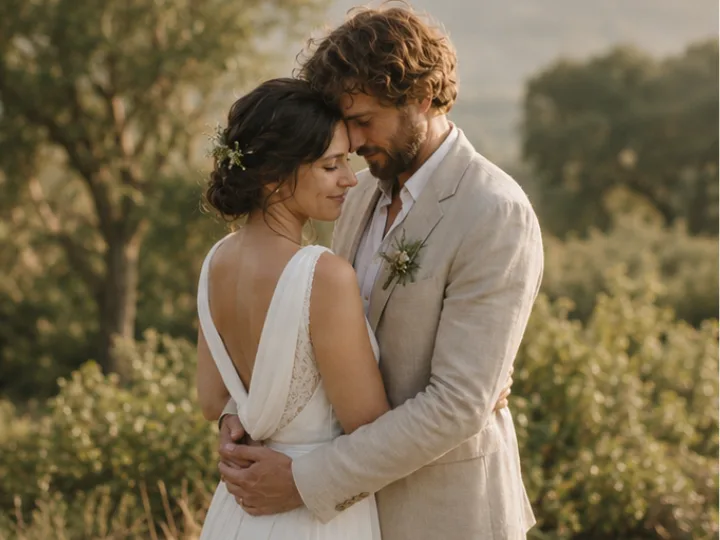
An eco-sensitive wedding means choices ranked by what actually weighs: travel first, venue second, food just after. Decoration and stationery come last, although almost everyone starts there. Do what you can, do it well, and feel guilty about none of it. A wedding that genuinely looks like the people living it is already, in itself, a success.
Would you like a wedding that looks like you, gentler on the planet, without spending your weekends on it? That is exactly what I do, with a supplier book already filtered on these criteria. Let us talk on a discovery call, or take a look at the Vert Émeraude package.
FAQ
Does an eco-friendly wedding cost more?▾
Is a destination wedding compatible with an eco-friendly one?▾
Can you have an eco-friendly wedding with two hundred guests?▾
Is DIY really greener?▾
How do we explain our choices to guests without lecturing them?▾
Would you like a wedding that truly reflects you? Book your free video discovery call:
Book my free video callCredits
Illustrative images, AI-generated or royalty-free.
Dear photographers,
Could your photos illustrate this article?
Text me!